Reporting vs. Prediction vs. Decision Intelligence
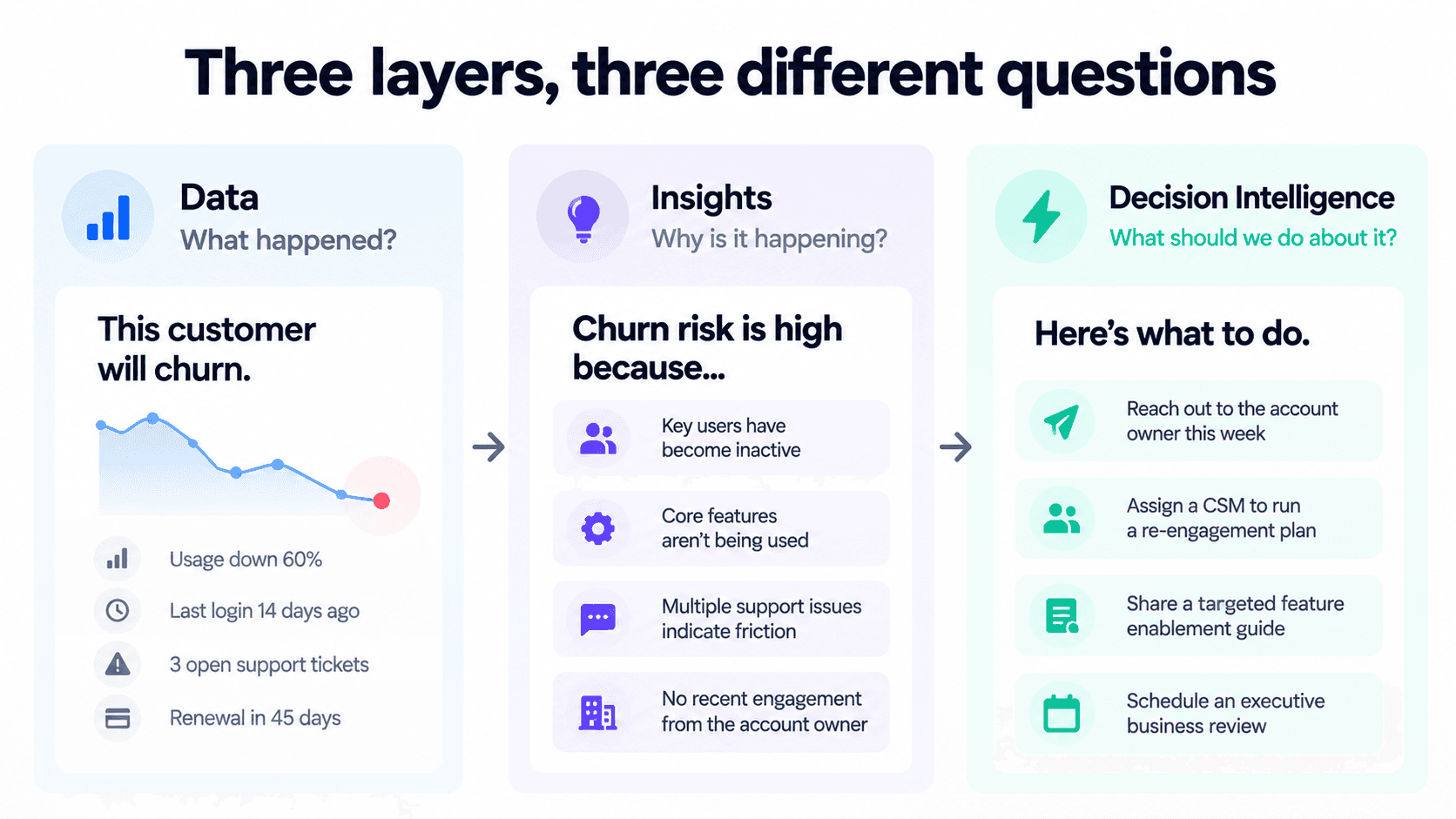
Knowing a customer will churn is not the same as knowing how to save them. Most customer intelligence still stops somewhere in between, and the gap has a shape worth naming precisely — because the three things get sold under the same word.
Three layers, three different questions
Reporting answers: what happened? Usage dropped 32% last month. Ticket volume doubled in Q2. Renewal rate in the mid-market segment fell four points. Reporting is retrospective by construction. It is also the most mature layer in almost every SaaS company, because it is the easiest to build and the easiest to buy.
Prediction answers: what might happen? This account has a 71% churn probability. This segment is trending toward downgrade at renewal. Prediction extends the historical record forward, and it is genuinely useful — it buys you time, which is the scarcest commodity in retention.
Decision intelligence answers: what should we do about it? Which of these eleven at-risk accounts do we work today. Why this one before that one. What specific action has a chance of changing the outcome. And when is the right move to do nothing at all.
The first two describe the customer. Only the third commits to a course of action.
Why prediction alone stalls
A churn probability is a useful number that is surprisingly hard to act on, for three reasons.
It doesn't rank against business value. A 71% risk on a $3k account and a 40% risk on a $180k account will sort in the wrong order on any list ordered by probability. Risk and stake are different axes, and only one of them is usually modelled.
It doesn't say what to do. "This customer is likely to churn" leaves the entire intervention unspecified. Reach out? Escalate? Offer a discount? Fix the open ticket first? The CSM still has to construct the plan, and two CSMs will construct different plans from the same score.
It doesn't explain itself. A score without its reasoning gets quietly ignored. If a CSM cannot see that the number came from a usage decline plus an unresolved ticket plus a champion who left, they have no basis to trust it over their own read of the relationship — and they will back their own read every time.
This is why so many teams buy a predictive scoring tool, watch adoption fade over two quarters, and conclude the model was wrong. Usually the model was fine. It just wasn't the thing standing between them and a decision.
What connecting signals to decisions requires
Moving from prediction to decision means answering three questions in one place.
Who should we focus on? A ranked, revenue-weighted list of accounts, short enough that a team can actually work it in a day. Prioritisation is the output, not a filter the user applies themselves.
Why now? The specific combination of signals that made this account urgent this week, stated plainly, drawn from across CRM, product usage, support and billing rather than any single system.
What action could change the outcome? A concrete recommended next step, with the reasoning attached, that a CSM can accept, modify or reject. Including, where the evidence supports it, the recommendation to wait.
Those three answers are what separate a system that informs from a system that decides.
Where customer intelligence is heading
Reporting looks back. Prediction looks ahead. Decision intelligence helps you decide what happens next — and as customer data volume keeps climbing, the constraint moves further away from observation and further toward judgement at scale.
That is the layer we are building at RetainIQ: it reads across the systems you already run, produces a prioritised set of accounts with the reasoning visible, and recommends the next action. It connects read-only by default, and nothing is written back to your CRM or billing platform unless your team approves it.
Our case studies show the three modules — Recover, Retain and Reactivate — working on real account data, and pricing is published in full.