Why We Built RetainIQ
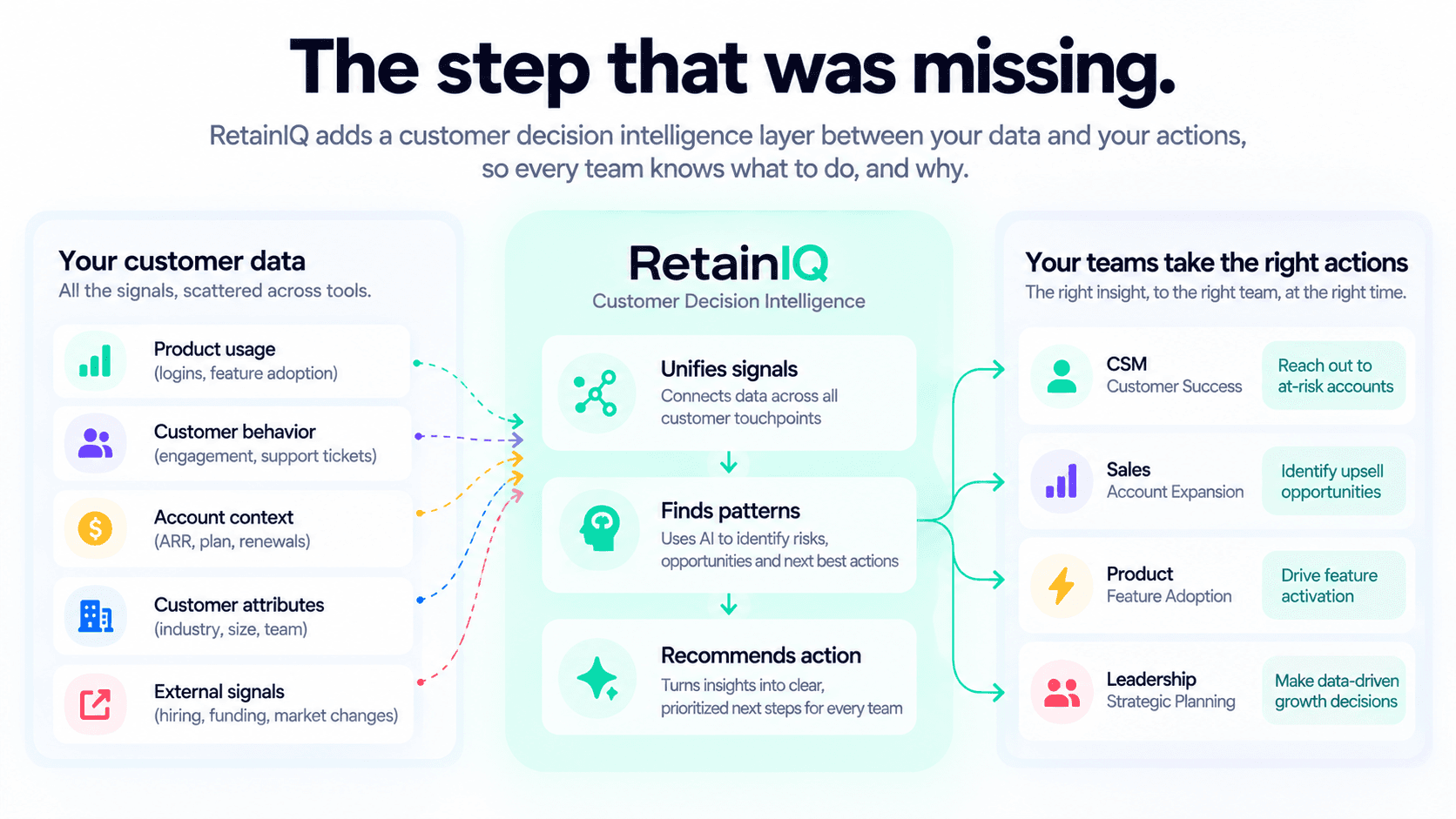
We didn't build RetainIQ to give companies more customer intelligence. There is already a great deal of customer intelligence available, and most of the teams we talk to are not short of it.
We built it because intelligence without a decision changes nothing.
The pattern we kept running into
Talk to enough customer success and revenue leaders and the same conversation repeats with small variations.
They can see the signals. Usage is instrumented, tickets are logged, payment events are captured. They can measure the risk — most have a health score of some kind, and some have a genuinely good predictive model. A few can predict churn with real accuracy weeks ahead of the event.
And then the conversation arrives at the same place every time. Someone still has to answer: what do we do now? And the harder question underneath it: who do we act on first?
That question rarely has a systematic answer. It gets resolved by a CSM's instinct, a weekly pipeline meeting, or whichever customer emailed most recently. The intelligence was real. It just stopped one step short of being useful.
The step that was missing
What struck us was that the gap wasn't technical sophistication. These teams had good data and, in several cases, good models. What they didn't have was a layer that took everything known about a customer and produced a decision from it.
Not: this customer is at risk.
But: this is why. This is what matters most. This is where to act first.
That is what customer decision intelligence means to us. It is a narrow claim, deliberately. We are not trying to be the system of record, or to replace the customer success platform a team already runs, or to become another dashboard competing for attention in a stack that has too many already.
We are trying to remove the manual work of connecting dots — the hour a CSM spends every morning reconstructing which accounts matter from four browser tabs — and replace it with a prioritised list they can trust, with the reasoning visible.
What we decided the product had to do
Three commitments shaped how we built it, and each one closed off options we might otherwise have taken.
It has to read your existing systems, not replace them. RetainIQ connects to the CRM, billing platform, support tool and product analytics you already run. Read-only by default. Nothing is written back unless your team explicitly approves the action.
Every recommendation has to explain itself. A prioritisation a team cannot interrogate is a prioritisation they will override the first time it disagrees with them — and they should. So every recommendation carries the signals it was built from and a confidence level.
The AI does not act on its own. Recommendations are reviewed by a person before anything happens. We think that is the correct design for a system touching customer relationships, and not only for compliance reasons. The CSM knows things about the account that no signal captures, and the product is better when it assumes that.
Less time connecting dots, more time changing outcomes
The outcome we are aiming at is narrow enough to state in one sentence: a revenue team should spend less of its week working out what to do, and more of it doing the thing that changes the result.
That's the gap RetainIQ is built to close. If it sounds like the gap you're working around, our case studies show the three modules running on real account data, and pricing is published openly.
We're also running a founding design-partner cohort, working directly with a small number of B2B SaaS teams on their own customer data. If that's of interest, get in touch.
— Chintamani, Founder, RetainIQ
Publishing checklist
Per post, before it goes live:
☐ Title, slug and meta description set exactly as specified
☐ Slug lowercase and hyphenated, no trailing punctuation
☐ Publish date set to the actual go-live day
☐ Internal links to /pricing and /case-study present and working
☐ Image placed where noted (posts 1 and 3 only)
☐ Post 4 attributed to Chintamani
Across the set:
☐ Both existing template posts unpublished (the cashless-transactions post and the omnichannel post)
☐ Redirects added from the two retired URLs if either has been crawled
☐ Posts staggered roughly a week apart, in the order 1, 2, 3, 4
☐ Blog index page shows the new posts and no stale drafts
☐ sitemap.xml reloaded after the final post and all four URLs present
Suggested order and cadence: post 1 first, since it addresses the broadest problem and is the most likely entry point from search. Posts 2 and 3 follow at weekly intervals. Post 4 last, once there is other content for a reader to arrive from.