Customer Stories
How Asterlane recovered $132K in failed subscription revenue in 90 days
Asterlane already knew when payments failed. RetainIQ helped the team identify which failures deserved attention first — turning $216K in revenue at risk into prioritized, human-reviewed recovery decisions.

“We weren’t short of payment data. We were short of judgment. We had hundreds of failures telling us something had gone wrong, but very little telling us which one deserved attention first.”
Maya Chen
VP Revenue Operations, Asterlane
Failed payments were visible. Priority wasn’t.
Asterlane’s Stripe billing caught every failed payment the moment it happened. That part worked. The harder problem came right after: deciding what to do with hundreds of failures a month.
A $320 decline from a small account and a $4,650 failure from a strategic customer could look identical in the billing queue — same status, same lack of context. Finance and RevOps had no fast way to tell which failures would resolve on their own, which needed a human, and which represented real revenue at risk.
Visibility wasn’t the problem. Prioritization was.
$216K was at risk, but every failure couldn’t be urgent
Over a 90-day period, roughly $216K in subscription revenue entered failed-payment status. Historically, Asterlane recovered about 25% of that through Stripe’s automatic retries and generic dunning emails — close to $54K, with the rest going unresolved or under-investigated.
The process wasn’t broken. It just asked too much manual judgment of a team that also had a business to run. Stripe could tell Asterlane exactly what failed. It couldn’t tell them what deserved attention now.
Account | Amount | Failure | Attempts | Priority | Action |
|---|---|---|---|---|---|
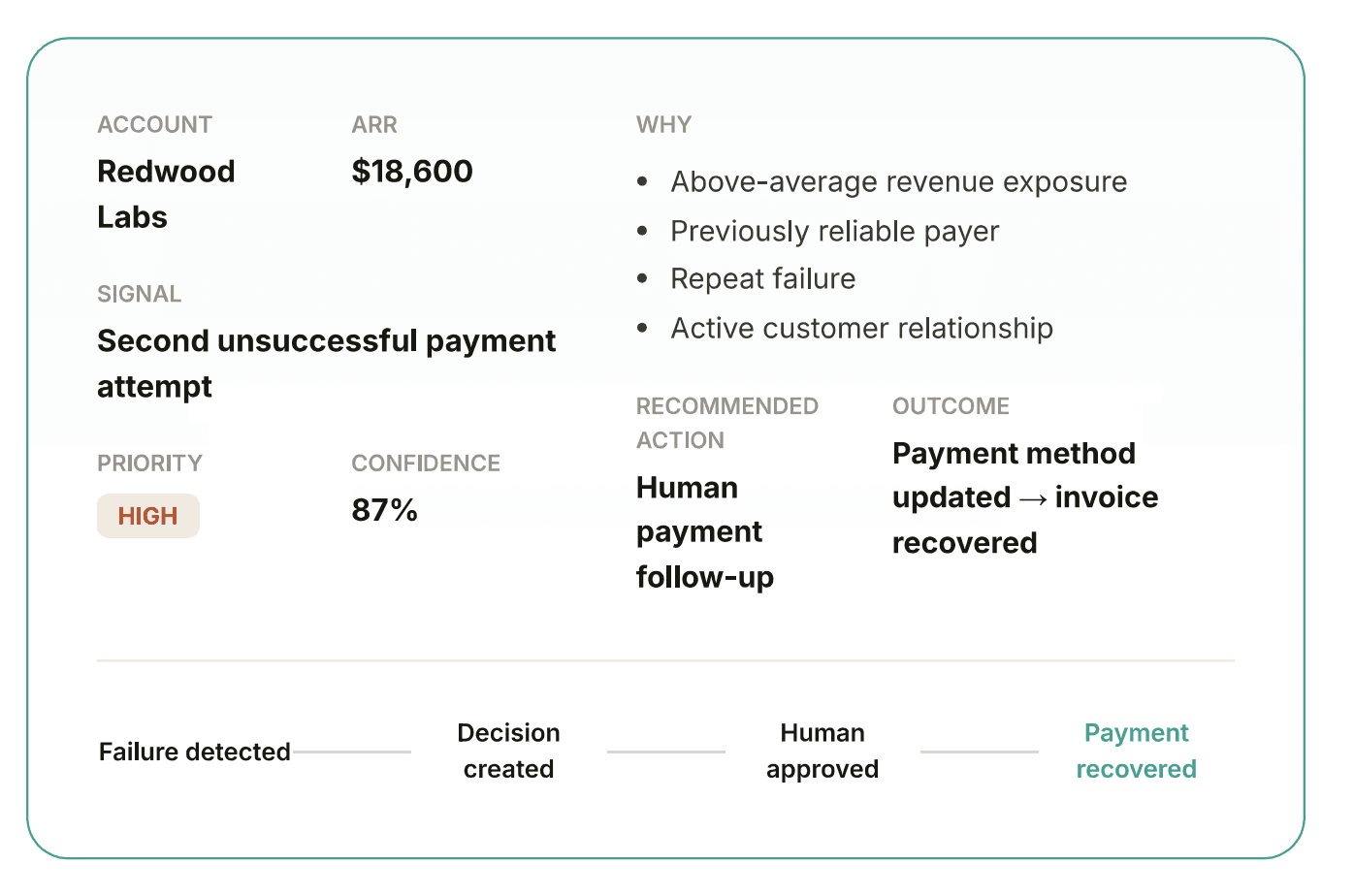
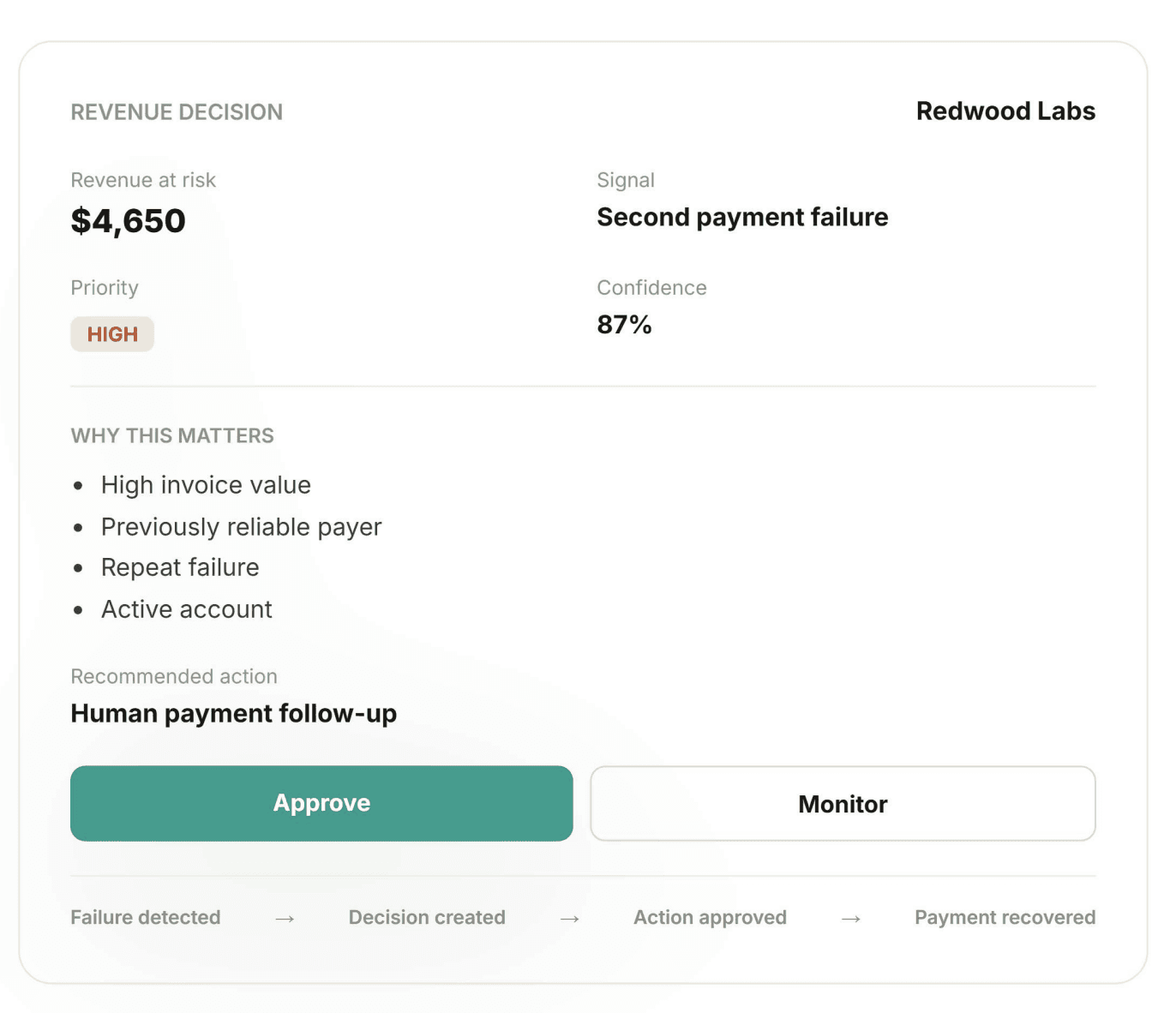
Redwood Labs | $4,650 | Insufficient funds | 2 | High | Contact account |
VelaWorks | $790 | Card expired | 1 | Medium | Update payment method |
Northbridge | $320 | Temporary decline | 1 | Monitor | Wait for retry |
Not every failure needs another email. Every failure needs the right decision.
RetainIQ changed the question from "What failed?" to "What should we do?"
For every failed payment, RetainIQ weighs the same context a sharp RevOps analyst would: payment amount, failure reason, attempt count, account ARR, payment history, and how active the customer relationship is. That context turns a flat list of failures into a ranked set of decisions.
The workflow stays deliberately simple: signal, interpretation, recommendation, human review, action, outcome. RetainIQ surfaces what it thinks matters and why, it doesn't contact customers or change anything on its own.
RetainIQ recommends.
A human reviews.
The action is approved.
The outcome is recorded.
The decision RetainIQ surfaced
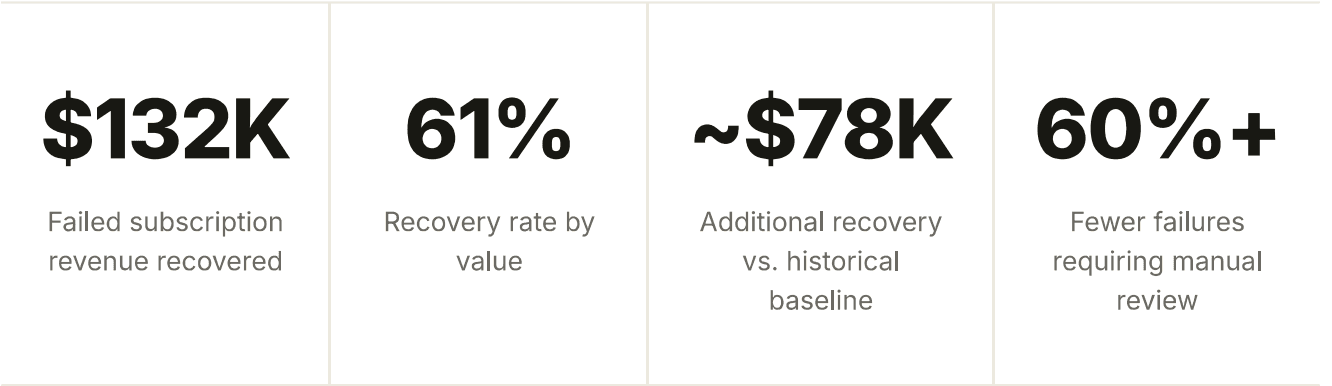
The improvement didn't come from sending more recovery emails or contacting every failed customer harder. It came from becoming more selective about where human attention went, spending it on high-ARR accounts and repeat failures, while lower-priority cases ran through standard retries untouched.
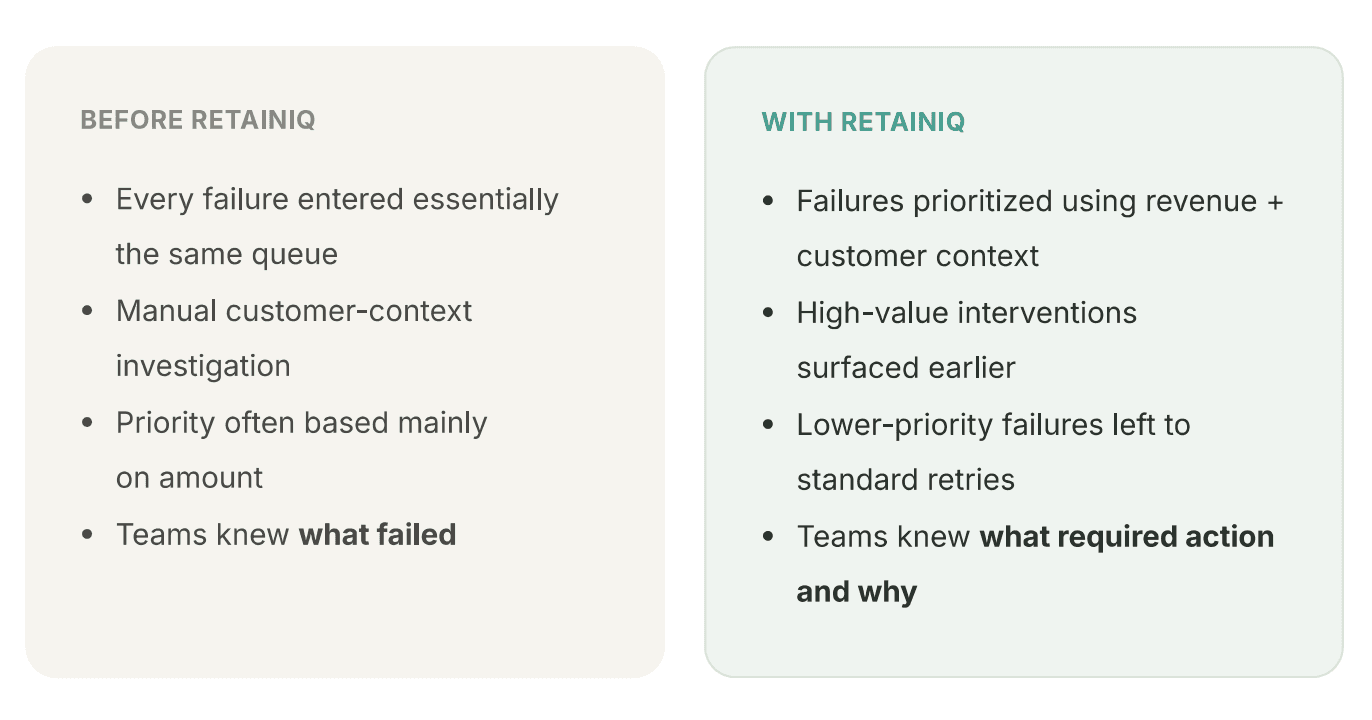
Recovery became a prioritization problem, not simply a retry problem
Asterlane didn't need another tool to tell it that payments had failed, Stripe already did that reliably. It needed to know which failures justified attention, which could wait, and what to do next.
With RetainIQ, mornings changed. Instead of starting with "What failed?", RevOps and Finance could start with "What deserves our attention today?" the shift behind turning $216K in revenue at risk into $132K recovered.
"The win wasn't sending more recovery emails. It was knowing when an email wasn't enough, and when we didn't need one at all."
Maya Chen
VP Revenue Operations, Asterlane